

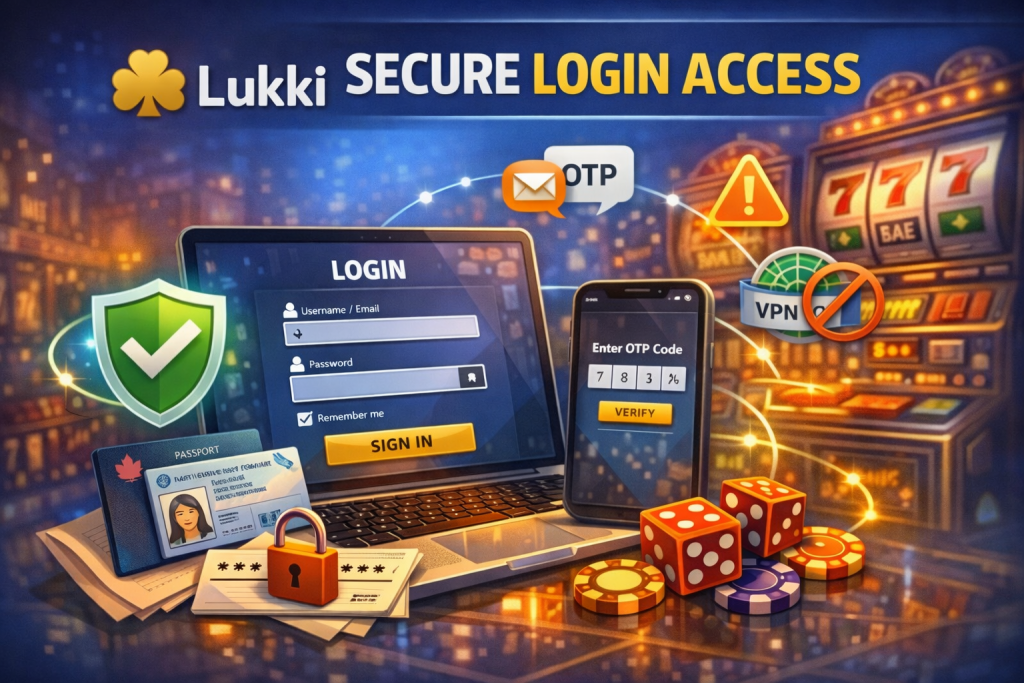
Accessing a casino account is a security-sensitive process that combines identity verification, encrypted authentication, and responsible access controls. This login guide explains how registered users enter their Lukki Casino accounts, how authentication works across devices, and what to do if access issues occur.
The guide is structured to support both new and returning users by outlining browser access, mobile compatibility, recovery procedures, and regional compliance requirements.
What Login Means in an Online Casino Environment
Account login is more than a username and password entry point. It functions as a secure identity gateway that connects:
- Personal profile data
- Payment records
- Gameplay history
- Responsible gambling settings
- Verification status
Modern casino authentication systems rely on layered security models, including encrypted session tokens, IP monitoring, and behavioural pattern detection.
Login credentials also determine eligibility for features such as account funding, withdrawal requests, and promotional participation.
For users who recently completed Sign up, the login stage becomes the first secure interaction with the account dashboard, where balance visibility, account tools, and platform navigation are centralised.
Browser vs Mobile Access
Lukki Casino supports multi-platform login environments. Users may access accounts via desktop browsers or mobile devices without compromising encryption standards.
Browser Login
Browser access remains the most commonly used method due to its stability and full interface display. Supported browsers typically include:
- Chrome
- Safari
- Firefox
- Edge
Browser sessions enable complete account visibility, including transaction logs and verification prompts.
Mobile Login
Mobile optimisation allows account entry through smartphone browsers or a dedicated App environment where supported. Mobile sessions use responsive frameworks that adjust navigation, authentication prompts, and dashboard layout to smaller screens.
While gameplay categories such as Games, Slots, and promotional Bonus tracking remain accessible after login, authentication requirements remain identical to desktop entry.
Step-by-Step Login Guide
The login process follows standardised authentication sequencing:
- Navigate to the official login page
- Enter registered email or username
- Input account password
- Complete CAPTCHA verification (if prompted)
- Confirm two-factor authentication (if enabled)
- Access the account dashboard
If authentication credentials match system records, access is granted instantly. Failed attempts may trigger security cooling periods.
Login Issues & Troubleshooting Table
| Issue | Possible Cause | Resolution | Security Impact |
|---|---|---|---|
| Incorrect password | Typing error / outdated credentials | Use password reset | Low |
| Account locked | Multiple failed attempts | Wait or contact support | Medium |
| OTP not received | Telecom delay / wrong number | Request resend | Medium |
| Browser incompatibility | Outdated software | Update browser | Low |
| VPN restriction | Geo-compliance triggers | Disable VPN | Medium |
| Device recognition block | New IP/device detected | Complete verification | High |
OTP Authentication Explained
One-Time Passwords (OTP) add a secondary identity layer during login. This temporary code is sent through SMS or email verification channels and expires within minutes.
OTP systems reduce unauthorised access risk by ensuring that login attempts require device possession, not just credential knowledge.
Canadian telecom security frameworks influence OTP reliability. Network congestion, roaming conditions, or spam filtering may delay delivery.
Authoritative telecom and cybersecurity references:
- Canadian Centre for Cyber Security
- Canadian Radio-television and Telecommunications Commission (CRTC)
- Public Safety Canada cyber awareness programs
These institutions outline authentication, SIM security, and identity protection standards relevant to digital login environments.
Security Tips for Account Access
Users can strengthen login safety by implementing practical measures:
- Enable two-factor authentication
- Avoid public Wi-Fi login sessions
- Use password managers
- Update credentials periodically
- Monitor login notifications
Encrypted SSL connections protect session traffic, but endpoint device security remains user-dependent.
Device Compatibility Overview
| Device Type | Supported | Login Method | Notes |
|---|---|---|---|
| Desktop PC | Yes | Browser | Full dashboard access |
| Laptop | Yes | Browser | Recommended for verification uploads |
| Smartphone | Yes | Mobile browser / App | Optimised UI |
| Tablet | Yes | Browser | Responsive interface |
| Smart TV | Limited | Not recommended | Restricted compatibility |
| Public terminals | Discouraged | Browser | Security risk |
Cybersecurity Infrastructure
Login environments operate within encrypted ecosystems governed by:
- SSL/TLS encryption
- Firewall network monitoring
- Behavioural fraud detection
- Session timeout protocols
Canadian cybersecurity authorities emphasise identity protection through multi-factor authentication and phishing awareness.
Reference institutions include:
- Canadian Centre for Cyber Security
- Get Cyber Safe Canada
- Innovation, Science and Economic Development Canada
These frameworks influence authentication architecture across regulated digital services.
Regional Access & Compliance
Login accessibility may vary depending on:
- Provincial compliance frameworks
- Identity verification completion
- Payment method validation
- Responsible gambling flags
Geo-monitoring systems detect access anomalies such as proxy routing or restricted jurisdiction login attempts.
Responsible Gambling Insert
Login systems integrate behavioural protection layers. Users may encounter:
- Session reminders
- Deposit limit alerts
- Cooling-off prompts
- Self-exclusion notifications
These features activate at login entry rather than gameplay stages, reinforcing preventive safeguards.
Password Reset Process
Password reset functionality is available through the login interface and follows a secure verification path.
Standard reset flow:
- Select “Forgot password” on the login page
- Enter registered email address
- Confirm identity via verification link or OTP
- Create a new password
- Re-authenticate via login form
Reset links typically expire within 15–60 minutes to minimise phishing or interception risk.
For enhanced security, users are advised to create passwords that include:
- Upper and lowercase characters
- Numeric values
- Special symbols
- Minimum length of 12 characters
Identity Verification During Recovery
If password recovery triggers fraud alerts, additional identity checks may apply.
Verification layers may include:
- Date of birth confirmation
- Account creation details
- Registered phone validation
- Government ID upload
- Payment method confirmation
These procedures ensure account restoration aligns with anti-fraud and anti-money laundering compliance frameworks.
Multi-Factor Authentication Recovery
Users who enabled two-factor authentication may require secondary recovery procedures if device access is lost.
Recovery options include:
- Backup authentication codes
- Email-based verification
- Manual support validation
- Device trust removal
Telecom-based OTP recovery depends on network stability and SIM ownership continuity.
Canadian telecom guidance highlights risks such as SIM-swap fraud, which can compromise authentication codes if mobile accounts are hijacked.
Relevant cybersecurity references:
- Canadian Centre for Cyber Security
- Communications Security Establishment Canada
- Canadian Anti-Fraud Centre
These agencies publish identity protection advisories relevant to login recovery security.
Account Lock & Security Freeze
Repeated login failures may trigger automated account locks. These protective freezes prevent credential-guessing attacks.
Common triggers:
- 5–10 failed login attempts
- Rapid IP switching
- Bot detection signals
- Suspicious geo-routing
Security freezes typically resolve through:
- Timed unlock periods
- Email verification
- Support intervention
- Identity re-authentication
Device Recognition Systems
Login security environments maintain device recognition registries.
When a new device attempts access, the system may request:
- Email confirmation
- OTP validation
- Security questions
- Location approval
Device fingerprinting tracks:
- Operating system
- Browser version
- IP address
- Screen resolution
- Language settings
This behavioural profiling reduces fraudulent session creation.
Session Management & Timeout Protocols
Active login sessions operate under timed security rules.
Standard session controls include:
- Automatic logout after inactivity
- Token expiration
- Concurrent session monitoring
- Forced logout after password changes
These safeguards reduce risk from unattended devices.
Recovery Access Comparison Table
| Recovery Method | Verification Required | Time to Restore | Security Level |
|---|---|---|---|
| Email reset link | Email access | Minutes | Medium |
| OTP recovery | Phone access | Minutes | High |
| ID verification | Document upload | Hours–Days | Very High |
| Support review | Manual validation | 24–72 hrs | Very High |
| Backup codes | Pre-generated tokens | Immediate | High |
Telecom Factors Affecting Login Access
Authentication systems relying on SMS verification may be influenced by telecom variables:
- Network congestion
- Roaming conditions
- Carrier filtering
- SIM transfer delays
Canadian telecom oversight bodies outline authentication delivery risks and mobile identity protections.
Reference organisations:
- Canadian Radio-television and Telecommunications Commission
- Innovation, Science and Economic Development Canada
- Get Cyber Safe Canada
These agencies publish guidance on SMS authentication reliability and telecom fraud prevention.
Regional & IP Compliance Monitoring
Login systems evaluate geographic routing to ensure access aligns with regulatory frameworks.
Risk indicators include:
- VPN masking
- Proxy routing
- High-risk jurisdiction IPs
- TOR network traffic
If triggered, users may face:
- Temporary login denial
- Identity verification prompts
- Security questionnaire checks
Compliance monitoring protects both account integrity and licensing obligations.
Behavioural Risk Detection
Security algorithms analyse login behaviour patterns such as:
- Typing cadence
- Session timing
- Navigation flow
- Device switching frequency
Irregular patterns may prompt step-up authentication, requiring additional verification before access approval.
Behavioural biometrics are increasingly used across financial and regulated digital platforms.
Responsible Gambling Integration at Login
Login portals may display behavioural protection tools prior to dashboard access.
These can include:
- Deposit limit alerts
- Session reminders
- Cooling-off options
- Self-exclusion confirmations
Embedding these prompts at login ensures protective mechanisms activate before gameplay engagement.
Security Infrastructure & Fraud Prevention Framework
Account login environments operate within multi-layered cybersecurity ecosystems designed to detect, prevent, and respond to unauthorised access attempts. These systems combine encryption, behavioural analytics, telecom verification, and compliance monitoring.
The login gateway functions as the first defence perimeter protecting personal data, transaction history, and gameplay records.
Encryption & Data Transmission Protection
All login credentials transmitted between user devices and platform servers are protected using encrypted communication protocols.
Primary encryption standards include:
- TLS (Transport Layer Security)
- HTTPS secure transport
- End-to-end credential hashing
- Tokenised session identifiers
Encryption ensures that:
- Passwords cannot be intercepted in plaintext
- Session tokens cannot be reused
- Login credentials remain unreadable during transit
Hashing frameworks store passwords using irreversible encryption algorithms, preventing database leaks from exposing usable credentials.
Authentication Token Systems
Following successful login validation, the platform generates session tokens rather than reusing credential authentication.
Token systems manage:
- Session validation
- Device authentication
- Activity authorisation
- Logout expiry
Token expiry reduces risk of:
- Session hijacking
- Credential replay attacks
- Unauthorised background access
Fraud Detection Algorithms
Login attempts are continuously monitored through automated risk-scoring engines.
Fraud indicators include:
- IP address anomalies
- Device mismatches
- Impossible travel patterns
- Repeated credential attempts
- Bot behaviour signals
Machine learning detection systems assign risk levels to login attempts. High-risk sessions may trigger:
- Step-up authentication
- Temporary login denial
- Manual review
- Account lock
IP Intelligence & Geo-Routing Analysis
IP analysis tools evaluate the origin of login requests in real time.
Security systems monitor:
- Geolocation mismatches
- VPN routing
- Proxy masking
- Blacklisted IP networks
If irregular routing is detected, additional verification layers may be applied before session authorisation.
This monitoring supports regional licensing compliance while preventing fraudulent cross-border access.
Behavioural Biometrics Monitoring
Behavioural biometrics adds an invisible security layer by analysing how users interact with login systems.
Behavioural indicators include:
- Typing rhythm
- Mouse movement patterns
- Scroll behaviour
- Touchscreen pressure patterns
These digital signatures help distinguish legitimate users from automated intrusion tools.
Account Activity Monitoring
Post-login activity monitoring continues after authentication approval.
Security systems track:
- Bet frequency patterns
- Session duration
- Transaction anomalies
- Device switching
If activity deviates from historical patterns, risk alerts may initiate protective responses such as session suspension or verification prompts.
Security Governance & Compliance Frameworks
Login environments operate within national cybersecurity compliance structures.
Relevant Canadian cybersecurity authorities publish authentication safety frameworks, including:
- Canadian Centre for Cyber Security
- Public Safety Canada
- Office of the Privacy Commissioner of Canada
These organisations provide guidance on:
- Credential storage
- Identity theft prevention
- Data breach response
- Authentication infrastructure
Telecommunications-related login verification is also influenced by carrier security frameworks monitored by:
- Canadian Radio-television and Telecommunications Commission
- Communications Security Establishment Canada
Platform Monitoring Infrastructure Table
| Security Layer | Function | Threat Mitigated | Automation Level |
|---|---|---|---|
| Encryption protocols | Protect data transmission | Credential interception | Fully automated |
| Token authentication | Manage session identity | Session hijacking | Automated |
| Fraud algorithms | Risk scoring | Brute force attacks | Automated + AI |
| IP intelligence | Geo verification | VPN / proxy misuse | Automated |
| Behaviour analytics | User pattern recognition | Bot intrusion | AI-assisted |
| Activity monitoring | Session behaviour tracking | Account takeover | Automated |
Telecom Authentication Security
SMS-based OTP authentication remains widely used but carries telecom-level risks.
Known telecom threats include:
- SIM swap fraud
- SMS interception
- Number porting abuse
- Carrier account breaches
Telecom regulators in Canada publish consumer protection advisories addressing mobile authentication fraud.
Recommended telecom security measures include:
- SIM PIN protection
- Carrier account passcodes
- Number porting locks
- SMS forwarding restrictions
Device Security Integration
Login security also depends on endpoint device protection.
Users are advised to maintain:
- Operating system updates
- Antivirus software
- Secure Wi-Fi connections
- Biometric device locks
Unsecured devices remain one of the most common vectors for credential theft.
Session Integrity Safeguards
Session protection systems maintain control after login completion.
Key safeguards include:
- Idle logout timers
- Concurrent login restrictions
- Forced logout after credential change
- IP revalidation
Session tokens automatically expire when risk thresholds are reached.
Audit Trails & Access Logs
All login attempts are recorded within security audit logs.
Recorded data includes:
- Timestamp
- IP address
- Device type
- Browser agent
- Success or failure status
These logs support:
- Fraud investigations
- Compliance reporting
- Account dispute resolution
Regulatory Compliance & Identity Protection
Authentication frameworks align with national data protection and privacy legislation.
Compliance objectives include:
- Identity safeguarding
- Data minimisation
- Secure credential storage
- Incident response readiness
Authentication infrastructure is periodically reviewed to maintain alignment with evolving cybersecurity standards.
Login & Responsible Gambling Integration
Access permissions may be affected by previously activated control settings.
Examples include:
- Deposit limit triggers
- Cooling-off periods
- Temporary suspensions
- Self-exclusion enrolment
If a restriction is active, login access may be:
- Fully blocked
- Temporarily delayed
- Limited in feature scope
This integration ensures that login permissions respect pre-configured behavioural boundaries.
Self-Exclusion Access Handling
When a self-exclusion programme is activated, authentication systems automatically enforce entry denial across all linked login points.
During exclusion:
- Login credentials remain stored but disabled
- Password resets are restricted
- Account recovery remains locked
- Access reactivation requires formal review
Reinstatement procedures only occur after exclusion periods expire and verification protocols are completed.
Session Duration Controls
Login approval does not guarantee unlimited platform access.
Session monitoring systems regulate duration through:
- Auto-logout timers
- Inactivity timeouts
- Daily session caps
- Behavioural triggers
These mechanisms prevent extended continuous access that could indicate compulsive engagement patterns.
Transactional Access Limitations
Authentication grants account entry but does not automatically authorise financial operations.
Additional safeguards may apply to:
- Withdrawal confirmations
- Payment method changes
- Personal data edits
- Security setting updates
These operations often require secondary identity verification.
Login Environment Compatibility Monitoring
Account access systems are engineered to support multi-device continuity while maintaining authentication integrity.
Supported login ecosystems include:
- Desktop browsers
- Mobile browsers
- Tablet devices
- Hybrid web-app environments
Session synchronisation ensures continuity without compromising credential protection.
Platform Comparison Table
| Login Environment | Security Depth | Verification Layers | Performance Stability | Recommended Use Case |
|---|---|---|---|---|
| Desktop browser | High | Password + OTP | Very stable | Full account management |
| Mobile browser | High | Password + OTP | Stable | Quick account access |
| Tablet browser | High | Password + OTP | Stable | Extended sessions |
| Dedicated mobile app | Very high | Biometric + OTP | Optimised | Frequent mobile users |
Connectivity & Network Reliability
Login performance depends heavily on network stability.
Authentication may fail or stall under conditions such as:
- Weak signal strength
- Public Wi-Fi instability
- Packet loss
- ISP routing delays
Secure private connections remain the most reliable access method.
Access Recovery Governance
If login credentials become inaccessible, structured recovery systems are activated.
Recovery verification layers include:
- Email identity confirmation
- SMS authentication
- Security question validation
- Device history verification
Recovery processing times vary based on risk scoring and documentation review requirements.
Regional Access Restrictions
Authentication gateways must comply with jurisdictional regulatory frameworks governing account entry permissions.
Access restrictions may apply due to:
- Licensing boundaries
- Identity verification failures
- Travel location changes
- Telecom routing conflicts
Users accessing accounts while travelling may encounter additional login verification layers.
Login Behaviour Risk Monitoring
Risk scoring engines analyse login behaviour longitudinally.
Indicators monitored include:
- Login frequency spikes
- Multi-location access attempts
- Device switching intensity
- Session overlap anomalies
Protective actions triggered may include:
- Credential resets
- Temporary locks
- Step-up authentication
- Compliance reviews
Login Issues Resolution Table
| Login Issue | Likely Cause | Resolution Method | Escalation Needed |
|---|---|---|---|
| Incorrect password | Credential mismatch | Password reset | No |
| OTP not received | Telecom delay | Resend code | Rare |
| Account locked | Multiple failed attempts | Cooling period wait | Sometimes |
| Device not recognised | New hardware login | Email verification | No |
| Region blocked | Geo-restriction | Compliance review | Yes |
| Session expired | Idle timeout | Re-login required | No |
Best Practices for Secure Login Access
Users can enhance account protection by adopting basic cybersecurity hygiene.
Recommended practices include:
- Use unique passwords
- Avoid credential sharing
- Enable OTP authentication
- Avoid public Wi-Fi login
- Update devices regularly
Authentication safety remains a shared responsibility between platform infrastructure and user behaviour.
Closing Access Advisory
Secure authentication is fundamental to maintaining account integrity, identity protection, and responsible platform engagement.
Login systems operate through coordinated cybersecurity, telecom verification, behavioural monitoring, and regulatory compliance frameworks designed to:
- Prevent unauthorised access
- Protect financial data
- Support behavioural safeguards
- Ensure lawful platform usage
Understanding authentication processes empowers users to maintain secure, uninterrupted access environments.
Login FAQ
Quick answers to common account access questions, including OTP delivery, device checks, and recovery options.
What should I do if I can’t log in?
Why is my account locked?
What is OTP and why do I need it?
I didn’t receive the OTP code — what should I check?
Can I log in from multiple devices?
Why was I signed out automatically?
How do I recover access if I forgot my password?
What if I no longer have access to my email or phone?
Do regional restrictions affect login?
Can responsible gambling tools block login?
How can I keep my account login secure?
Tip: If you’re having repeated login issues, try clearing cookies/cache for the site or testing a private/incognito window to rule out saved-session conflicts.